Organic material, delivered
Reviewed, source-separated loads brought to your parcel on an agreed schedule. The condition gate is enforced at collection, so packaging and trash never ride along.
Commercial pickup in Harris, Fort Bend, and Montgomery County
Weekly drum swap · $10/barrel · no contract
For farmers and landowners
OnFarmCompost brings source-separated food scraps, manure, and carbon material to partner farms, manages the sheet composting in place, and leaves the finished compost on the ground that made it. No compost yard on your side, and no finished product to buy back.
We are actively adding partner farms in Harris, Fort Bend, and Montgomery County through 2026.
Not every parcel fits, and nothing is delivered before someone walks yours. New to the idea? Start with what land conditioning is.
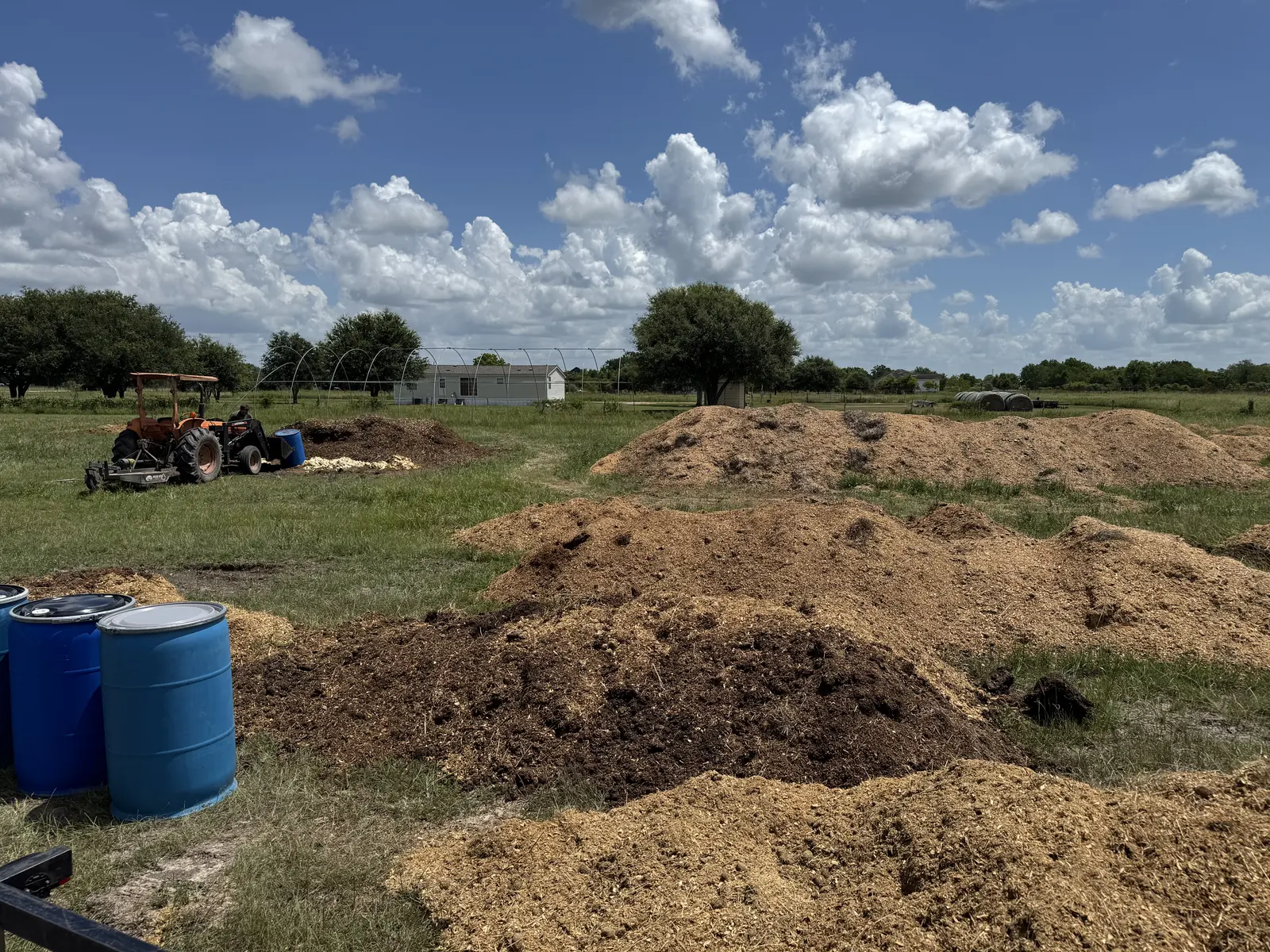
A partner-farm compost area in progress. The rows are built from delivered food scraps and carbon, and everything they become stays on this farm.
The offer
Reviewed, source-separated loads brought to your parcel on an agreed schedule. The condition gate is enforced at collection, so packaging and trash never ride along.
Layout, carbon balance, moisture, and records are OnFarmCompost’s job, at whatever level of involvement the site needs, from planning support through a fully managed composting area.
Nothing is hauled off, sold, or split. What the layers become belongs to the parcel they were built on. That is the economic case for hosting.
Whether a given arrangement pays the farm, charges it, or neither depends on the site, the material, and the volume, and is settled after the site visit. The constant across every arrangement is that the finished material stays.
Fit
A farm can have plenty of acreage and still be a poor compost site. Working that out early is cheaper for everyone, so here is the honest shape of it.
If a screened, bagged product on a delivery date is what you actually need, buying finished compost is the better route, and that is a fine answer.
Next step
Nothing is delivered before someone walks the parcel. The visit is where every question that could stop a project gets asked early, while it is still cheap to answer. It is free, and it needs an appointment.
Regulatory fit
Texas treats feedstocks differently: vegetative material and manure sit in a different tier than meat, dairy, or fish, and some materials are not accepted at all. Classification is confirmed for the specific site and material before the first load, and that work happens with you rather than being handed to you.
This page describes the offer. It is not a permit determination, an agronomic prescription, or an authorization to receive a material.
The condition every load must meet
Organic material must arrive source-separated or depackaged. Streams that arrive mixed with packaging or general trash are not accepted.
This matters more to the receiving farm than to anyone else. A mixed load becomes the landowner's problem forever, because the plastic and film stay in the ground. Those loads are refused at collection instead of passed along to your parcel, which is why general restaurant back-of-house waste is turned away rather than routed to a farm.
Engagement levels
The site visit settles which one fits your parcel and your appetite for involvement.
01
Reviewed material delivered on an agreed schedule once the site checks pass. You run the process, and we keep the stream clean and consistent.
02
You operate, we plan it with you: feedstock inventory, carbon and moisture plan, layout, records, and soil-use objectives. Considering your own facility? See whether EQIP can help fund it.
03
OnFarmCompost runs the composting area on your land under a defined scope with named roles, records, and review points. A defined scope, not a blanket promise to handle everything.
Evidence
Compost application raising soil organic carbon is well supported by field trials, and building organic matter is the honest core of the case for hosting.
What no one can promise is your yield or your fertilizer bill. Compost is not a drop-in fertilizer replacement, and on the heavy clay common near the Gulf Coast it does not meaningfully raise water-holding capacity. The response on your ground depends on starting soil, rate, crop, drainage, and management.
So the working rule is simple: baseline soil test before the first delivery, the same measurements afterward, on a schedule. If a result is real it will show up there.
On cost, hosting removes screening, bagging, retail markup, and return transport, and adds process and management costs on your side. The complete comparison is worked out per parcel at the site visit, and the land conditioning page has the side-by-side.
Sheet composting builds organic material and carbon in managed layers directly on the land that will use the result, instead of producing a screened retail product at a separate yard and hauling it back. The material composts where it lies, and the finished compost stays on that ground. It still needs a suitable site, known feedstocks, moisture and runoff management, and the authorizations that apply to the specific material.
Delivery of reviewed, source-separated organic material to your parcel, management of the composting process on your ground, and a finished result that stays on your land. Depending on the site, that can mean feedstock delivery alone, consulting on an operation you run yourself, or a managed composting area with defined roles and records. A site visit settles which fits.
The site visit is free. It does need an appointment, because it means someone walking your parcel with you rather than a phone call, and the useful version takes real time on the ground. Call or send the property details and we will find a date.
Terms are settled per farm after a site visit, and they vary with the site, the material, and the volume. Do not assume either a payment or a charge in advance. What is fixed in every arrangement is that the finished compost stays on your land.
Source-separated or depackaged organics, manure, and carbon material, on a schedule agreed before the first load. Organic material must arrive source-separated or depackaged. Streams that arrive mixed with packaging or general trash are not accepted. Sorting is never pushed onto the receiving farm, and the exact material list for your site is fixed at the site review.
It depends on your parcel and what you pay today. Hosting removes screening, bagging, retail markup, and the cost of hauling a finished product in, but the process still consumes carbon, water, labor, and management attention. The comparison that matters is complete delivered-and-applied cost for your ground, worked out at the site visit rather than promised on a page.
Raising soil organic carbon through compost application is well supported by field trials, and building organic matter is the reason to do this. What cannot be promised is a yield or a fertilizer bill: the response depends on your starting soil, application rate, crop, drainage, and management. Compost is not a drop-in fertilizer replacement, and on the heavy clay common near the Gulf Coast it does not meaningfully raise water-holding capacity. A baseline soil test before the first delivery lets you measure the change instead of guessing.
OnFarmCompost works with farms and landowners in Harris County and Fort Bend County and Montgomery County, Texas. Being inside the counties is the starting point, not the guarantee: route, access, material, and regulatory fit are confirmed for the specific parcel.
They are handled differently, and some are not handled at all. Each feedstock carries its own nutrient, odor, storage, and regulatory profile. Grease-trap waste, mixed municipal waste, and animal carcasses are not interchangeable with source-separated food scraps or ordinary manure. The material list for your site is fixed before anything is delivered, and that review is what keeps the wrong load off your land.
Someone walks the parcel with you. The visit covers access for delivery vehicles, drainage and flood exposure, setbacks from wells, water bodies, and property lines, neighbors, space for material, feedstock fit, and the regulatory classification that applies to your site and material. Nothing is delivered before that walk happens.
Not to start the conversation. Equipment needs depend on which engagement level fits, and regulatory classification is worked out with you for the specific site and material rather than left for you to research alone. Bring what you know about the parcel and its history, and the site visit fills in the rest.
See the agricultural recycling overview for the broader material-flow model.
Share the property location, acreage, current use, access, drainage, and what you want the ground to become. A site visit settles the rest, including terms. The visit is free and booked by appointment.
Verification anchors: TCEQ composting and mulching guidance; USDA NRCS Texas soil-health and conservation resources; Texas A&M AgriLife Extension; site records and operator evidence. Requirements and agronomic recommendations must be verified for the specific material, parcel, and intended use.